

Matter Matters
Resurrection invites us to trust that God gives not only our souls but our bodies and the good earth God's own permanence.

Between Acts 2 and Acts 10, Peter gives four sermons on the cross (Acts 2:14-40, Acts 3:12-26, Acts 4:5-12, Acts 10:28-47), and all four tell the story with these or very similar words: “You murdered Jesus” and “God raised him from the dead.”
The crucifixion—the beating, the crown of thorns, the mocking, the nails, the wood, the gambling for his clothes, the humiliation—is something we did to God, not something God did to God’s Son.
The cross, by contrast, is what God makes of our crucifixions (of Jesus and all the others in history), what God makes of all that we intend for evil.
God converts the crucifixion into the cross, into the highest possible good for all humans and the cosmos—and only God can do that.
We cannot convert our violence to good ends or make something good or true or beautiful from violence. Only Someone who does no violence can bring violence to an end.
God never needs or intends or uses evil, but God can and God does convert evil, just as he converts the violence Joseph’s brothers did to Joseph—selling him into bondage and shame in Egypt—not only to Joseph’s good but also to theirs. God rescues not only the crucified but those who crucify.
Violence can never be redemptive or beneficial, but God is able, in a mystery, to bring from our greatest evil a restorative love that heals all persons and all things.
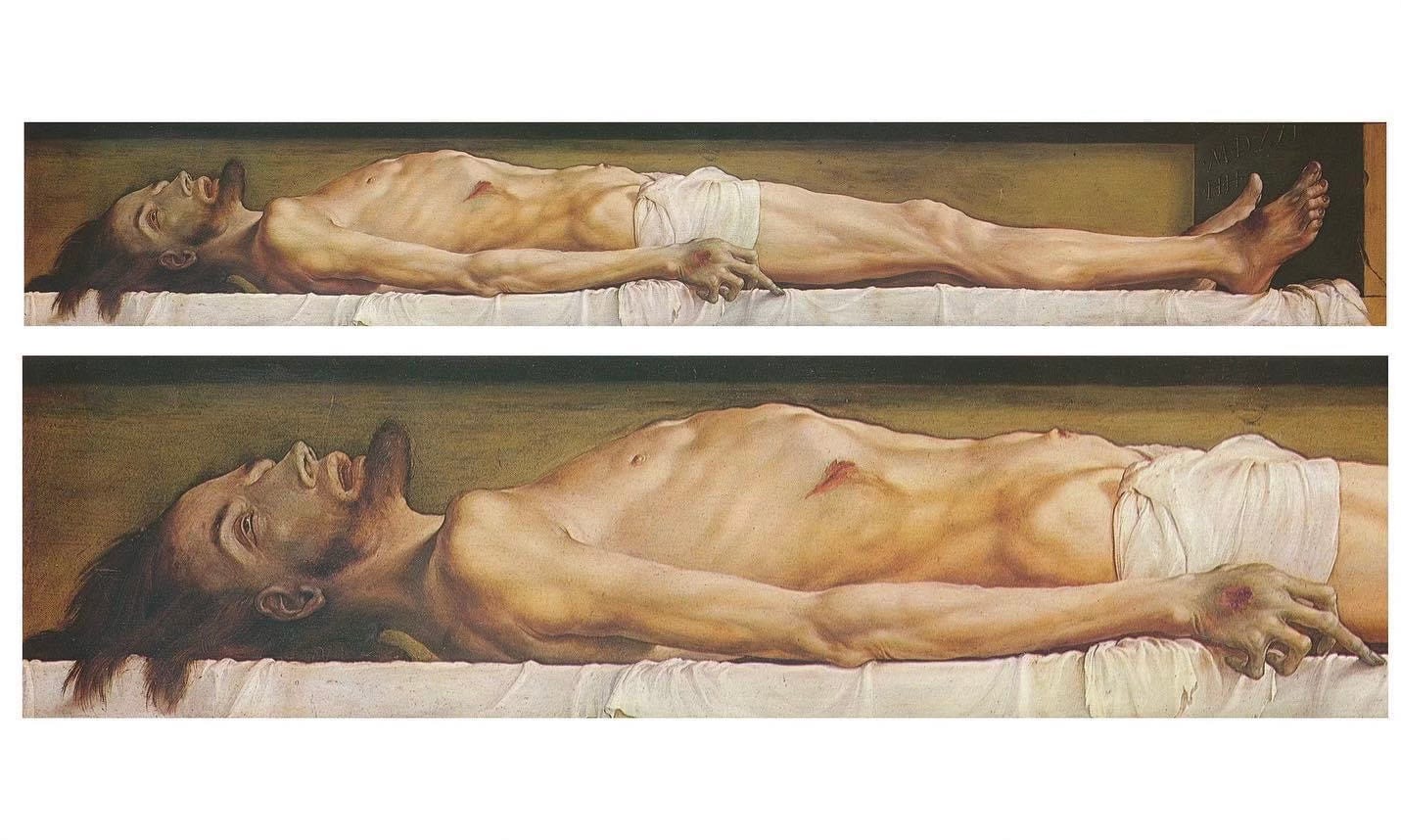
Yes, Peter’s sermon in Acts 2 says that all this happens by “the definite plan and foreknowledge of God,” but that does not mean, as some teach, that we are God’s agents in carrying out the murder of his own son, but rather that in wisdom the Father, who knows everything that will happen before it happens, foresees what we will do to the Son.
When for love of the world the Father sends the Son into the world not to condemn the world but that the world through the Son might be saved, the Father foreknew that we would reject and murder the Son and his plan is to intend our evil for our good. This is the way cruciform sovereignty works: it starts with a weakness that is somehow stronger than any force in the universe, rescuing us not from death but through it to a life without end.
The history of God-with-us in the flesh of Jesus and apostles like James teach us not to read Isaiah 53:10 (“it was the will of the Father to crush him with affliction”) as “The Father is the one acting in the Roman soldier who makes gashes in the back of Jesus, the crowd who mocks him, the executioner who fastens his hands and feet to wood.” We can easily see that this is false when we read what the eyewitnesses report happened to Jesus.
The agency is ours. And yet God surrenders, allows this harm, and voluntarily gives Godself up to crucifixion. By the cross we come to see that somehow surrender is the mode of God’s sovereignty.
Many things can be true at once: yes, nothing can happen unless God allows it, and Jesus willingly laid down his life (“I have power to lay it down, and I have power to take it again”), yet we are not acting as God’s agents when we kill Jesus. God knew from before the worlds were made that we would do what we did and we did in fact do it, and God made something good beyond what we could ever imagine—something satan could never imagine—from the crucifixion of the Son of God.
God does what only God can do with our evils: the Father uses the occasion of our worst violence to our human brother, what we do to our Lord and God, and makes of this most terrible event the greatest possible good and mercy and conversion for us and for the cosmos.
And here we are today, standing with the eleven, hiding behind closed and locked doors and, according to the gospel we just heard, suddenly the resurrected Jesus appears. He speaks peace over his disciples three times: Peace not vengeance for their betrayals; Peace not anger at their denials; Peace not recrimination for their abandonments. Christ speaks peace and only peace over them three times, and breathes the Holy Spirit on them.
In Luke’s account of this same moment, Jesus asks for food and eats dried fish and honeycomb. Is Jesus a ghost, a projection from his followers deep grief? No. He tells them to look again, to see that he is flesh and bones and not an apparition. Yet, his resurrected body is somehow transfigured because he can appear in a room without climbing in through a window or walking through a door.
His resurrected body interacts differently with known physics, which must mean that the world now yields to resurrection and not death; that laws of physics are transcended by what happens in Christ’s body when it is raised from death. The resurrection apparently has laws of its own. Those of us still walking around with death in our bodies run into walls but resurrected bodies pass right through them.
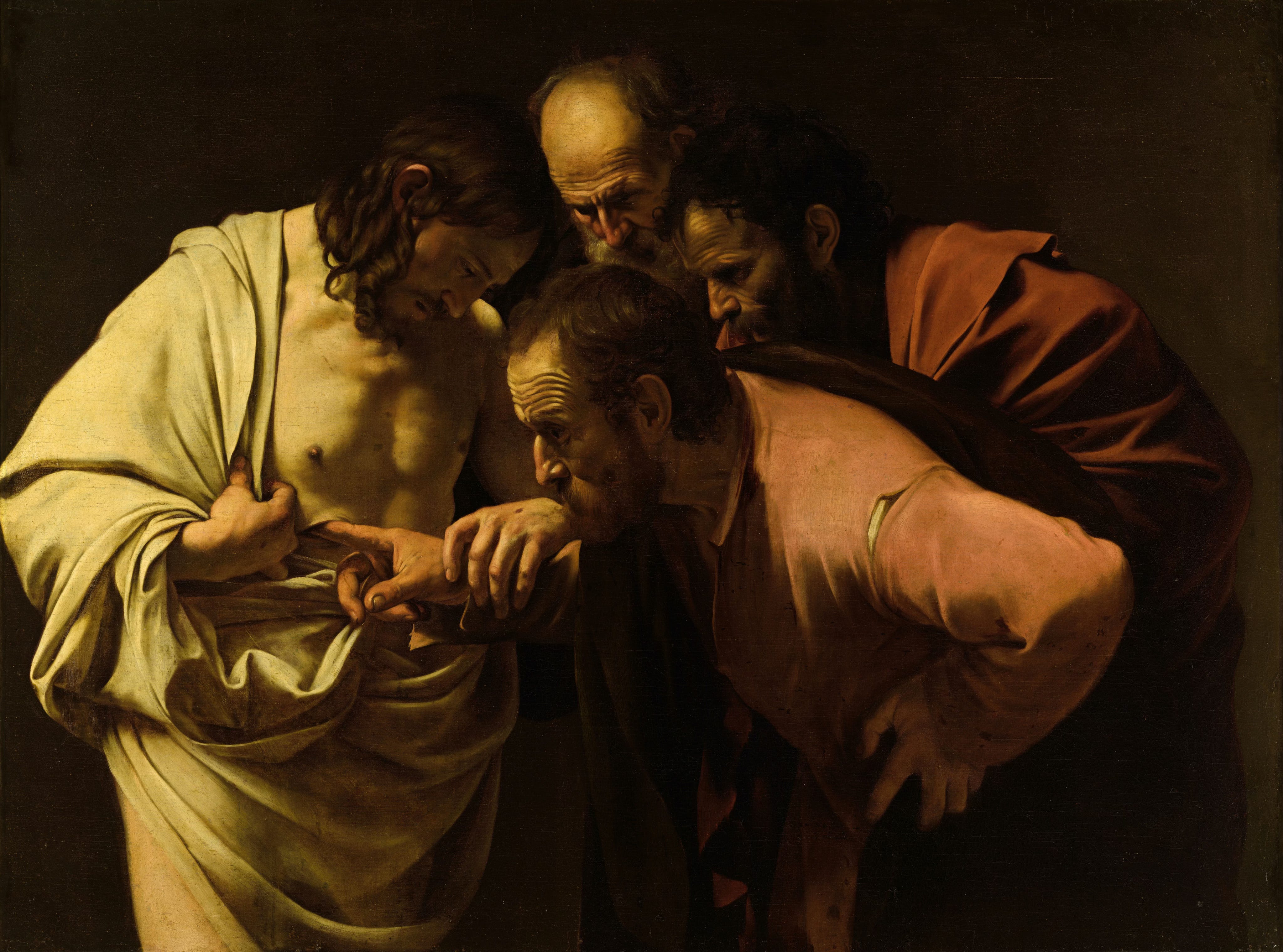
And Thomas doesn’t see any of this, because he’s not afraid and so is not there with them that first night. Thomas tells the rest that he wants to see the wounds of his friend before he will trust their testimony. Jesus consents to his request. God shows his wounds to the wounded, to heal Thomas and the others; shows them that their wounds are not the end of their story but only the next to last chapter.
In the end all wounds are transfigured and cleansed by the Father, as the Septuagint wisely renders Isaish 53:10: “The Lord is willing to cleanse him of the injury,” and to cleanse us of ours.
And with Thomas, we who have not seen, cry out, “My Lord and my God.”
As Jonathan Lane writes:
Thomas is our patron Saint:
For those who see blindly,
And for the blind who see.
And we are Saint Thomas as well:
Gazing upon the wounds of God,
With shaking hands outstretched,
Hoping against hope
And finding it always true;
That his wounds match ours,
And that his healing means
Ours will come as well.
If the resurrection isn’t an event of history that somehow also transcends history—something that happens not only in time but also to time, that happens to everything, everywhere, all at once—then every analogy or metaphor we label “resurrection” is simply nonsense, like the transhumanist idea that in our deaths we become part of a “singularity” where our “true selves,” our consciousness (which is for them all we ever are), is merged with the digital world.
But if the resurrection is both actual and eternal then it is limitlessly relatable and transferable. A flower that comes up from a dead seed or a marriage that comes back from the abyss or the moral of any good story, whether fact or fiction, can generate intense meaning in our minds and hearts, if the resurrection is not an abstraction or wish fulfilment or untrue.
Resurrection is so many things but it is so many things because the human God actually died, was numbered among the unclean corpses lying lifeless in the grave, and then death could not hold him—and not just his personality but his body.
Let’s learn the lessons of resurrection, which teach us not to reject the analog world God made good from the beginning, nor to think of resurrection as returning as ghosts or as hints of ourselves in some artificial, disembodied intelligence.
In the time of Jesus and the first Christians, dualism was in the air people breathed. To narrow a complex set of beliefs, one form of dualism taught that the material world is bad and the spiritual world is good. The body is evil. The earth is evil and it’s desirable to escape the body and world to a spiritual realm of perfections.
Christianity got infected with it and the fever never quite went away.
This is what dualism sounds like now: “Religion is bad. I’m into relationship.” “Buildings aren’t the church, people are.” “Sacraments are merely tokens. What matters is what’s happening in your heart.”
Each of those statements sounds right. Some of these name what happens when Jesus leaves the room or the religion, and some of these falsely divide things that belong together—the material and the spiritual—and some of it is simply dead wrong.
What these sentiments all share is a downgrading of the communal and physical and an elevation of the individual and spiritual; a pitting of invisible experience over the material means God uses to draw us into union with the divine nature.
When you say baptism is just a symbol, you’re saying the water doesn’t matter. When you say communion is just a memorial, you’re saying the bread and wine don’t matter. When you say the church building is irrelevant, you’re saying that gathering as the people of God is optional.
When you strip Christianity down to an internal experience between you and God, you’ve removed the body (in all its modes) from the faith. But God has always worked through the material world not beneath or above or around it.
When God makes the world, he declares it good and only good, for God only makes good things. The world is not evil. Our bodies are not evil. God formed Adam and Eve from the same clay. He spoke through burning bushes and donkeys. He fed his people with bread that came down from the sky. He took on flesh, bled real blood, and rose in a real and transfigured body.
God did not send a feeling into our hearts. He sent himself, in a body. After the resurrection, he doesn’t shed that body. He keeps it. He eats fish. He shows his wounds. He ascends bodily. Yes, that body is transfigured and so reveals that reality is now subject to the resurrection and not death; and that body appears in bread and wine, and in the poor and the prisoner and the sick, and in all of us when two or more gather.
And if none of this is true, why bother with Christmas and Easter? Why take on human flesh? Why die in a human body? Why raise that body from the grave?
Because Jesus shows us that bodies matter. Because Jesus tells us sacraments matter. Matter matters.
We do not worship water or bread or gathering places or crosses, but God has promised to work through them. God’s promise is connected to the water in the font. God’s presence is plated on the table.
To strip the material away and replace it with internal experience (which we should also not discard) is to tell God that what he has done with the world in making it and then remaking it doesn’t matter.
So many Christians and churches have absorbed this framework so deeply that we don’t even recognize it. We’ve been trained to distrust the physical and prioritize the spiritual without realizing we’re agreeing with an ancient heresy. The material and eternity belong together as the very person of Jesus Christ reveals!
Christianity is not about escaping the world. It is about how God somehow makes the world permanent, makes the world heaven. God works through water, bread, wine, oil, words spoken out loud, mud, saliva, symbols inked on paper, and bodies in a room.
If your faith has no room for the flesh of Jesus or those in whom Jesus tells us he is present to us—the hungry grimy-faced drifter, the imperiled refugee and his children dusty from the desert and cold, the convict in irons, the cancer patient who cannot afford their last trial medication—it has less room for the gospel than you think.
i have been reflecting on the deeper parts of the resurrection and also what we actually do to live out the gospel. i love how you bring to light the physical realities of heaven on earth!