
Easter Preachers
God entrusts the story of resurrection to those who remain in the hardest places.

Some of us will recall the 2001 film Bridget Jones’s Diary, very roughly based on Jane Austen’s Pride and Prejudice, in which Mark Darcy says to Bridget Jones that he “likes her very much … just as you are.”
Darcy sees Bridget’s quirks and bad habits and strange family and still—inexplicably, even to himself—regards her as a person he admires and desires.
There’s so much about being a woman that I cannot imagine, and so much about being a woman in the time of Jesus (or even today) that I would not want to imagine—like no one believing what you have to say, nor trusting you as a witness to what actually happens—but I like to think the women in the gospels are drawn to Jesus because, like Mark Darcy, Jesus loves them just as he finds them—“just as they are.” But with the vital exception that, unlike Mark Darcy, Jesus does not need or desire them in the way other men do, and never treats them in any way that makes them feel subservient or beneath him as a man. Not once.
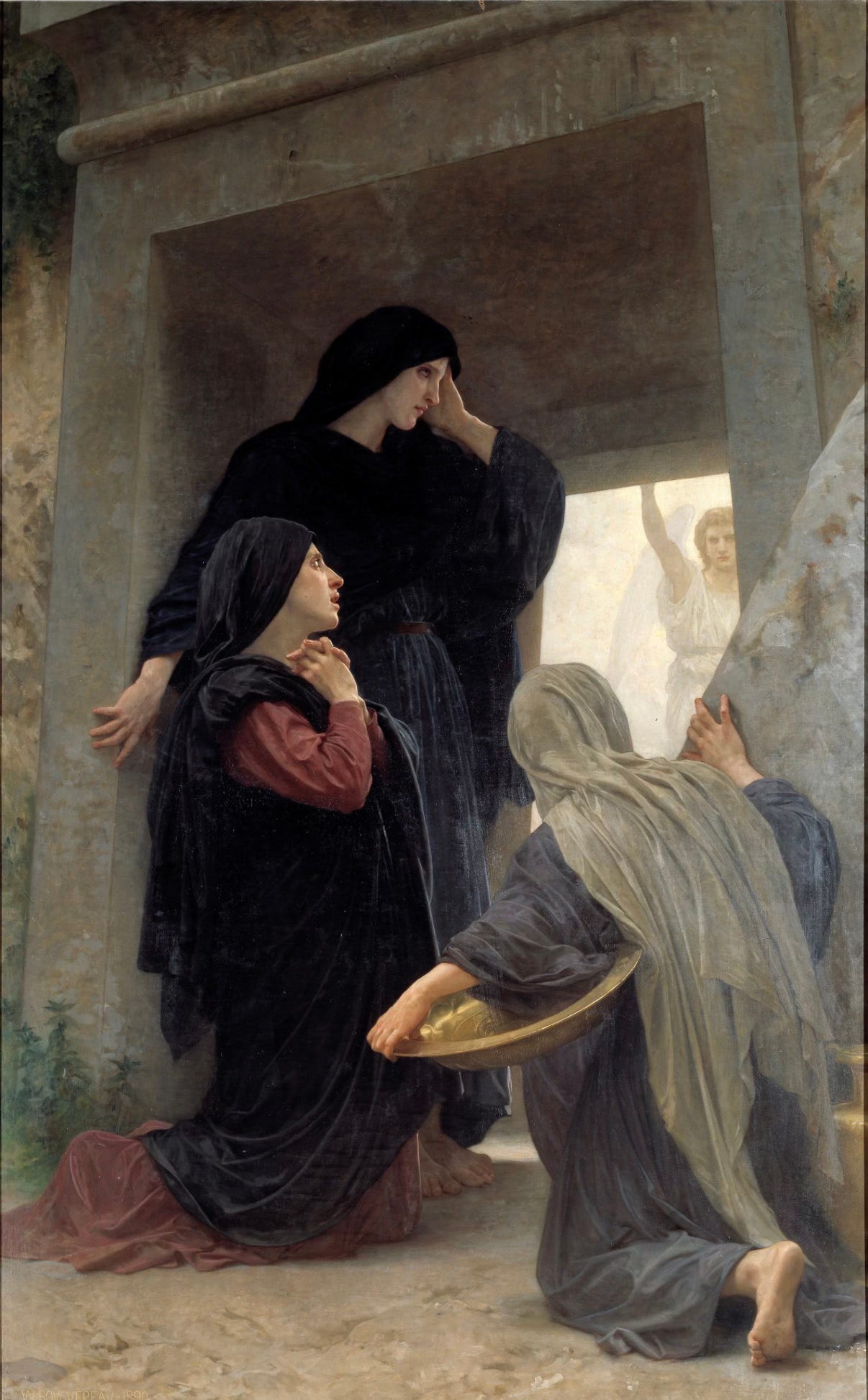
Jesus believes them and Jesus believes in them.
Also, unlike Darcy, Jesus’ love for them is not inexplicable to Jesus. Jesus loves them as he loves himself, knows why he loves them as they are, knows them better than they know themselves, even before he meets them. These women feel the eternality of his regard for them, and his trust in them, from the moment he enters their lives. He knows their stories.
There is a difference in the way Jesus interacts with women—the way he listens to them, the care he takes for them—that brings out the extravagant gestures of feminine affection for Jesus we read about in the gospels, as when Mary of Bethany anoints the feet of Jesus with scarlet perfume and wipes them with her hair. It is an act of authentic love, plain and simple. Jesus tells the other astonished and scandalized guests that she is preparing him for burial. She is already in mourning, six days before his death.
And the women stay with Jesus in his death, standing by and near the foot of the cross as he bleeds out and cries out and breathes his last. With John the beloved they remain with Jesus in the hardest things. And like John they are eyewitnesses of his passion.
And now, after two long nights of grief and heartbreak, it is early morning, just before the dawn. In the darkness, these women—tradition calls them “the myrrh-bearers”—long to be near the body of the One who loves them just as they are without pretense or expectation, who implicitly trusts them, with a love that guides them toward union with the God who dreams them up from eternity and gives them the specific life they each of them uniquely are so that they might bear not only his image but his likeness.
As they journey to the garden in the stillness of night, they ponder their sad task: to redress Jesus’ corpse with the spices and oils they carry and to finish the proper burial rituals, a burial that on Friday had been rushed, as Malcolm Guite describes:
“…they anoint the skin that cannot feel
Soothing his ruined flesh with tender care,
Kissing the wounds they know they cannot heal,
With incense scenting only empty air”
Have you ever seen the painting by Maurice Denis, “Burial or Entombment,” depicting the funeral procession from Golgotha to the garden grave? The image’s radiant yellows and deep blacks are punctuated by the stark white of Jesus’s linen-wrapped body. One of the women leans in and kisses the shrouded forehead of Jesus. This is the devotion that Jesus inspired in them.
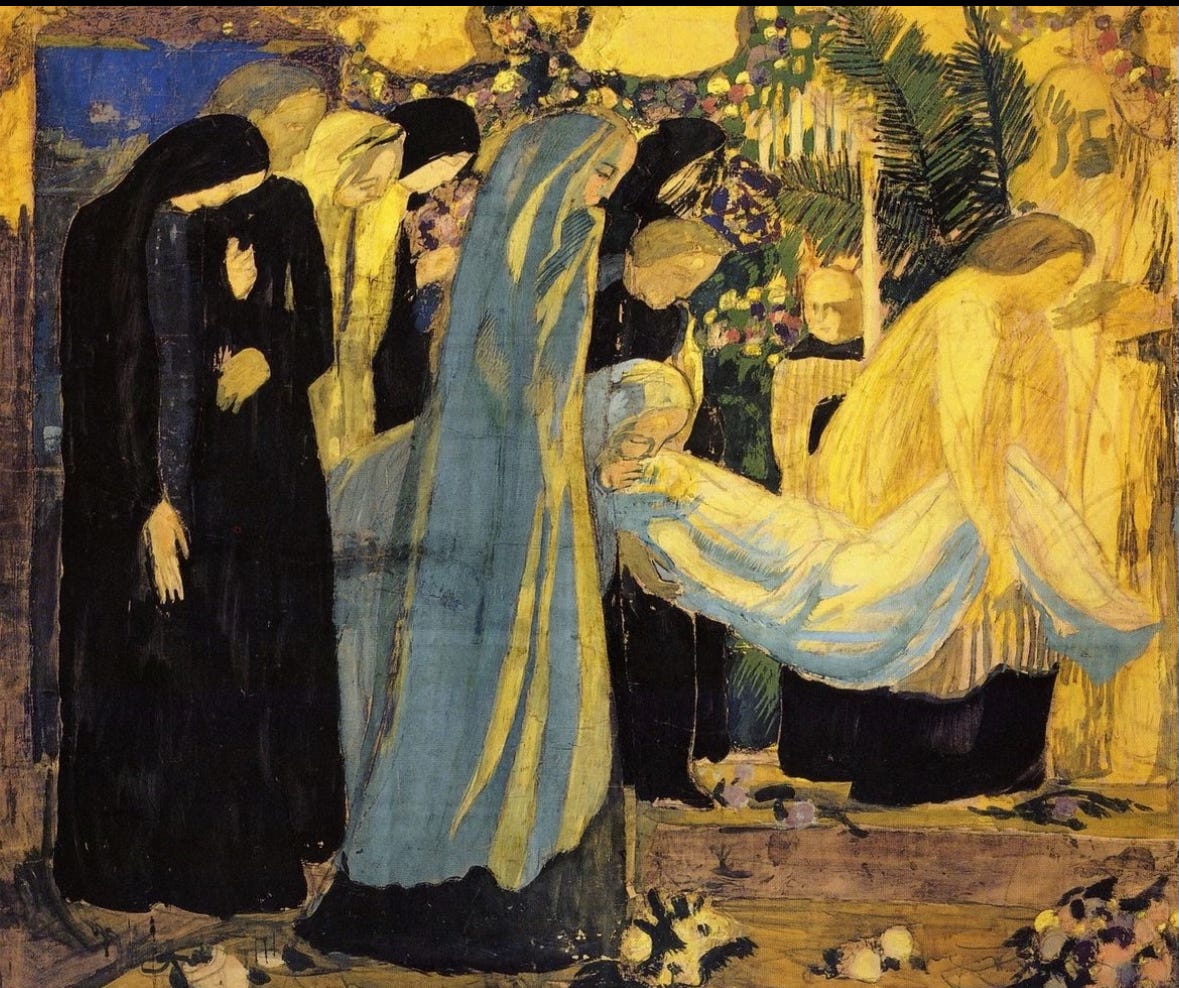
They know the way to the tomb, and they know a large stone has been rolled over the entrance of the grave, for they watched Joseph of Arimathea and Nicodemus lay him in the new tomb that had been carved into solid rock. They heard the sound stone makes on stone as the massive wheel was rolled against the entrance to the tomb. They know they need to convince the guard, or someone, to help them remove it. But will they find someone willing?
They arrive and find the tomb is already open. As in the moment of Christ’s death, there is a “great earthquake,” and an angel whose appearance “is like lightening” descends and rolls back the stone. From his perch atop the stone, his clothing white like snow, his strobe-like figure, flickering between visibility and invisibility, causes disorientation in the guard, who are prostrate on the ground like dead men, but also, like the ground, somehow shaking.
But not the women. The angel has the same message for them that the resurrected Jesus has for everyone, then and now: “Do not be afraid.” He tells them that Jesus is no longer in the tomb, to come and look where he once lay dead as a doornail, to see that he is indeed raised from the dead and on the move. He tells them: “This is my message to you.” And we hear the angel today, right now. His message is also for us. His message is for everyone.
The angel tells the women to go tell the men that Jesus will meet them all in Galilee. But as with the disciples that afternoon, and later that evening, the risen Jesus cannot wait to make an appearance. Even as they rush to tell the men with a strange mixture of fear and joy, Jesus meets the women on their way. Jesus suddenly appears and says “Hello” and they fall to the ground and embrace his feet in worship. His hands are no longer frozen by death in the contortion his torturers imposed on them when the nails were driven into his flesh. Jesus places his gentle, trustworthy, risen hands on their shoulders.
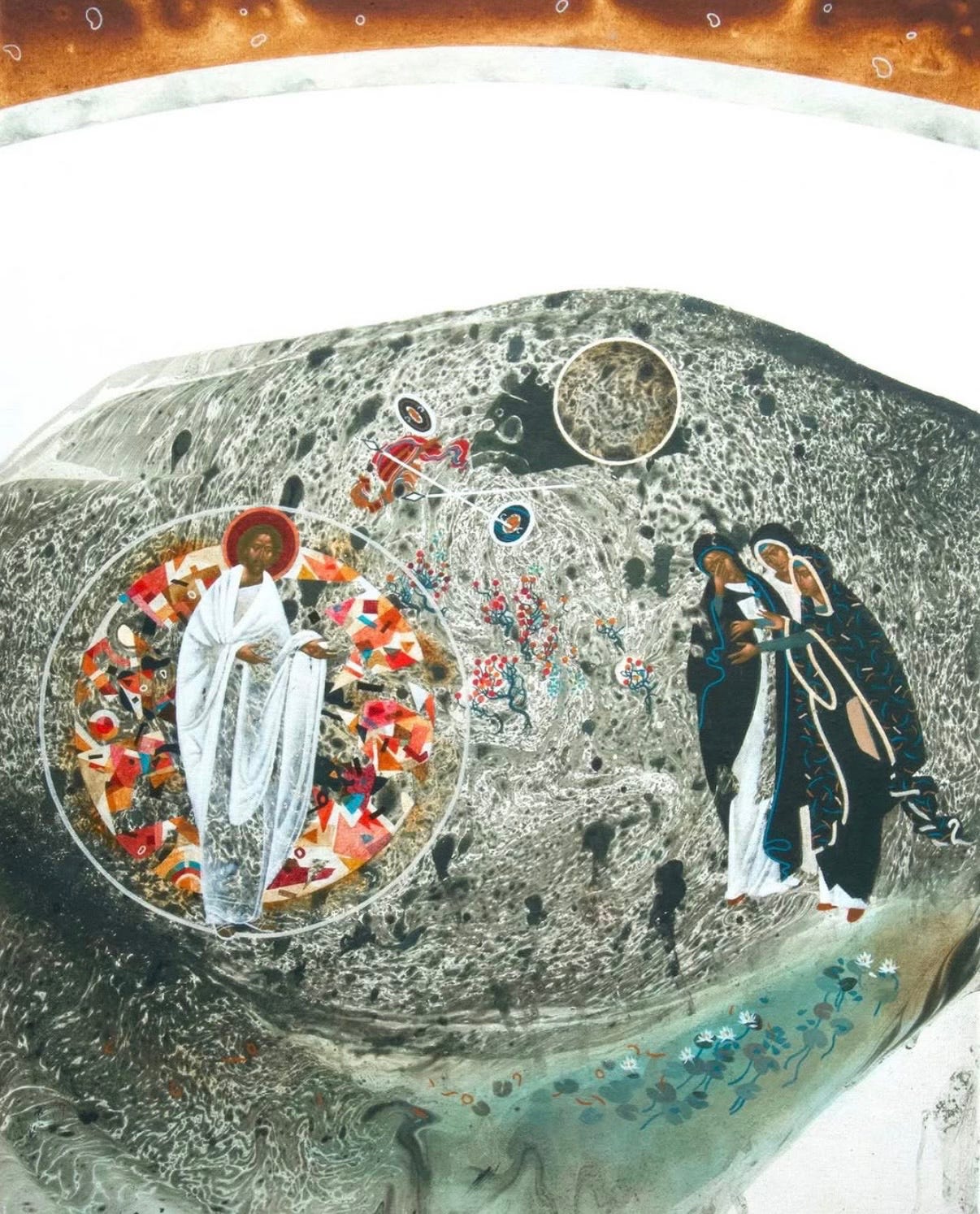
We are told by Isaiah that the feet of those who preach good news are beautiful and these women adore the feet of Jesus. The words Jesus speaks as they caress his feet are the best news they have ever heard and will ever hear, their human brother and friend, their Lord and God, forever back from death tells them, “Do not be afraid.” This is the best news any human facing death can hear.
And Jesus is not alone in being back from death forever.
Near the end of the Stations we prayed on Friday afternoon, at the Twelfth Station, the one where Jesus dies, we read in Matthew about the great earthquake that happened in the moment of Jesus’ death, how the veil in the Temple was torn in two from top to bottom, but also how, in a great mystery, “The bodies of many godly men and women who had died were raised from the dead.” Matthew says this happens when Jesus dies.
And, at this same Station, right next to Matthew’s witness, we read these words from Jesus in John’s gospel: “I tell you the truth, unless a kernel of wheat is planted in the soil and dies, it remains alone. But its death will produce many new kernels—a plentiful harvest of new lives.”
Jesus dies and in that moment resurrection begins. And it has been at work ever since, even in this Good Friday and Holy Saturday world, horrific as it is with death, where we keep on killing one another and burying our dead.
We need courage to trust in the resurrection, to be people with beautiful feet, who bring good news to this world of violence.
I walked three small groups through the Stations on Friday, and each time around we came to the prayer that asks for such courage, the one where Peter denies Jesus three times. We prayed that we might be ever ready to “give a reason for the hope that is in us.” Ponder that prayer with me for a moment.
We can never argue anyone to a place of hope. As the Rev John Ames of Gilead fame says, “nothing true about God can be said from a posture of defense.”
We cannot force anyone to trust in the resurrection. But by the Spirit we can speak resurrection and practice it. We run rehearsals for the opening of all tombs, we glimpse Easter, we trust that love is stronger than death, in the ashes of a Holy Saturday world.
If you find yourself in hell, a victim of natural disaster, drowned by your own ruined heart and participations in evil—do not be afraid or lose hope. A preacher is going to come, the crucified Creator. He loves you just as you are. He is endlessly patient and will in the end transfigure us. He will not leave us as we are. He will make us shine as he and the holy ones shine; he will make us shine like the sun, but unlike our sun, we will shine forever.
Yes. I did not know what I was expecting when I first started praying the other year. But the more I sit with Him, the more He brings stuff out of my heart that I didn’t even know was there 🥹 He knows what He’s about
So beautifully written Fr Kenneth. I sensed further transformation occurring within me even as I was reading… thank you.